
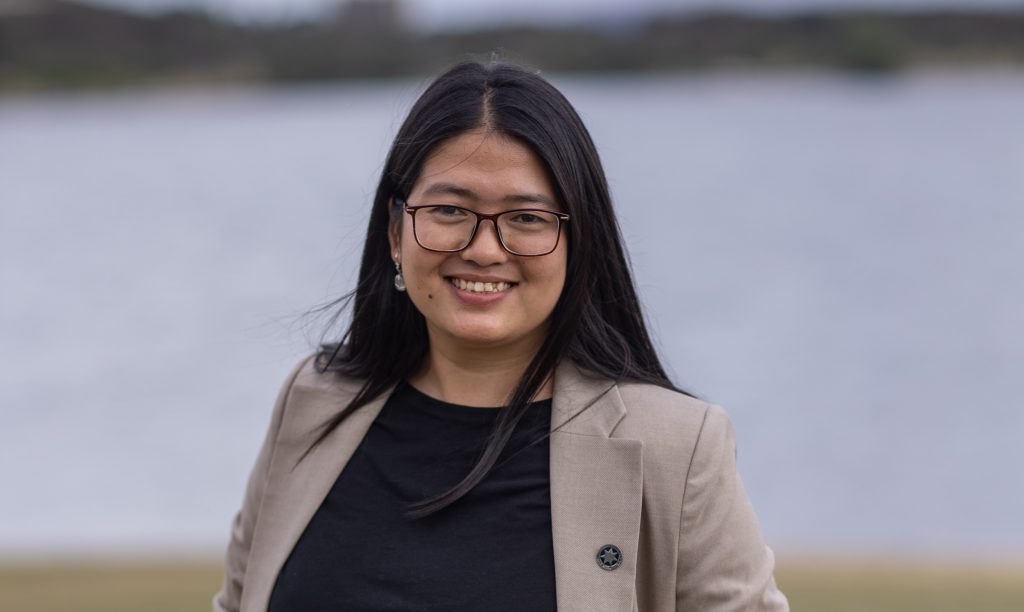
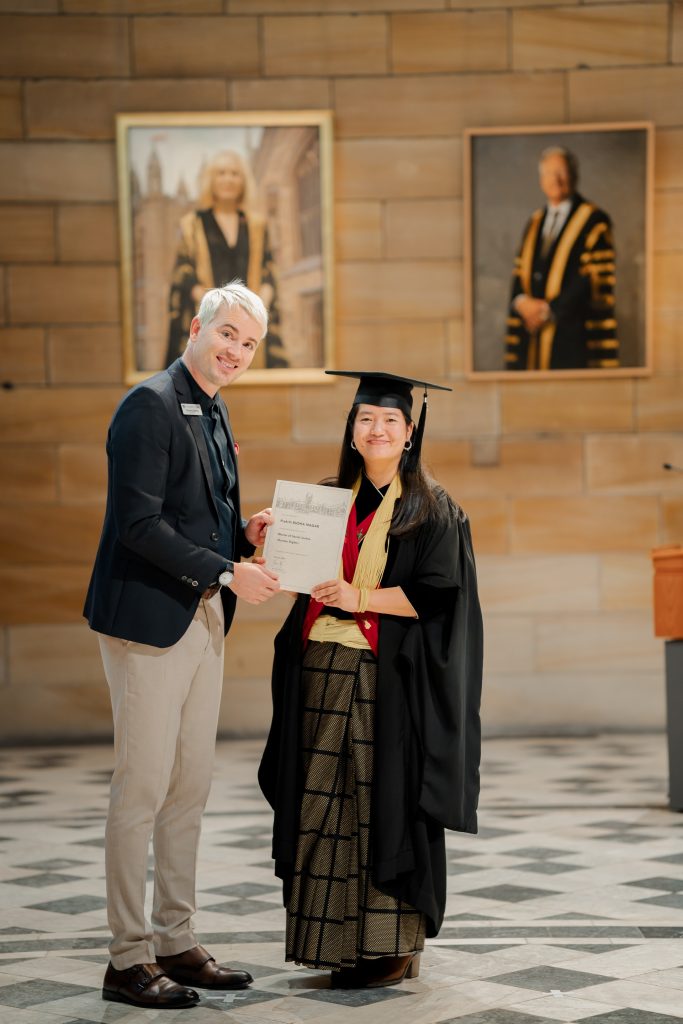
The University of Sydney hosted a Completion Ceremony to celebrate 114 internationally sponsored students completing their studies in the first semester. They recognised academic achievement, resilience and the power of global connection. They were also inspired by Prakriti Budha Magar, a scholar from Nepal who shared her Australia Awards journey.
“I am Prakriti Budha Magar, an indigenous woman from Nepal, a lawyer by profession and a Master of Social Justice graduate. This celebration is both a personal achievement and a meaningful milestone for my community. Today was possible because of our collective dreams.
The story of my life begins under a tree, where my mother gave birth to me in our remote village ‘Jhumlawang’ in Rukum, Nepal. These are the realities of Indigenous lives, especially in geographically and politically marginalised regions like Rukum, where struggle begins not after birth, but with it. Until recently, my village had no access to basic infrastructure – no roads, no hospitals, and no higher education institutions. My place existed on the periphery of state concern – out of sight, and therefore out of mind.
The decade-long civil war also began in Rukum and Rolpa, and the place was framed as the Maoist heartland. As a child growing up during the conflict years, I am aware of the impacts of war beyond bullets. One of my most vivid childhood memories is of helicopters hovering above our houses, stories of houses reduced to ash and of relatives attacked in nearby villages. I remember people clinging to radio broadcasts, hoping for an end to the war.
While I cannot recall every detail, what remains etched in my memory is the profound sense of fear, and equally, a quiet hope. It was the conflict’s impact on schools and my parents’ pursuit of education for their children that prompted them to move to Kathmandu, the capital city of Nepal. I still recall my awe at the first sight of city lights – the electric bulbs glittering like stars.
I had a similar experience when I landed in Australia. As a student from the global south, I had many ‘firsts’ here. I took my first international flight, had my first personal room, my first hotpot, first walking campus tour, first cultural immersion, first indigenous bush walk, free books in the street libraries, free sanitary pads and tampons at the university. I achieved my first perfect scores, participated in my first food justice field trip to Bangalore and the Sydney policy reform project. I served as the Postgraduate Vice President of the Sydney University Nepali Society, and as a casual academic staff member at USYD. I arrived as an Australia Awards scholar, but today I graduate wearing many hats.
I decided to pursue a Master of Social Justice because it offered an interdisciplinary grounding in development, peace and conflict, and human rights from the prism of social justice. The course suited my aspirations to build expertise in addressing human rights and social justice challenges back home and to amplify my work as a human rights lawyer in Nepal, where I intend to improve access to justice of Indigenous people and champion the rights of the most marginalised.
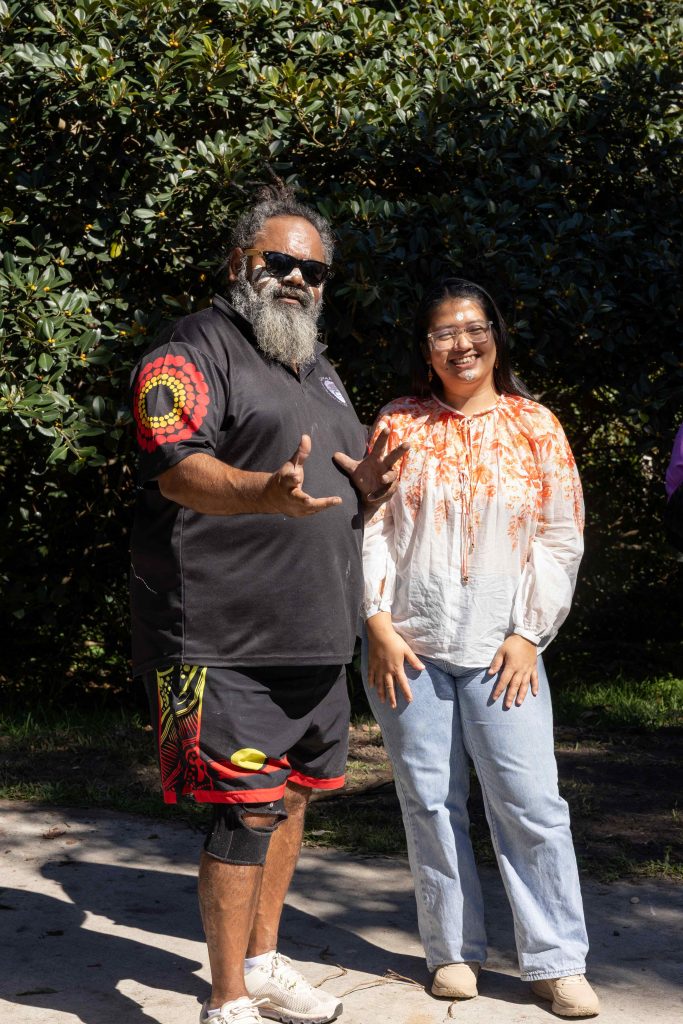
Today, I stand very proud of my decision. The University of Sydney has become a sacred learning ground for me, and I have grown as a thinker, doer and an intellectual in this Gadigal land. I am grateful to the brilliant and inspiring faculty members who have shaped my learning. Beyond the classroom, I engaged deeply with Indigenous communities across Australia, sharing panels, attending traditional Aboriginal cultural workshops, conferences and joining scholars’ forums. These experiences introduced me to Indigenous knowledge systems, and I have learnt in the Indigenous way, with all four aspects of my being: mind, body, emotion, and spirit. They introduced me to ‘yarning circles’ and ‘different ways of knowing’, the value of indigenous knowledge and reinforced my connection to country. These networks with inspirational torchbearers have evolved into global alliances for human rights and social justice and their words of wisdom will forever guide my work.
Studying social justice meant critically examining power, privilege, history, and justice. It was not just for the sake of gaining knowledge, but for the sake of change. We learned to see injustice not as isolated incidents, but as systems that can be unlearned, reimagined, and rebuilt. We wrestled with uncomfortable truths, questioned established norms, and studied the lived experiences of voices often silenced. It has not been only about what’s wrong but reimagining how to make things right.
As I return home, I will continue working as a lawyer, academic, socio-legal researcher, and development practitioner, focusing on Indigenous rights, Dalit rights, gender justice, policy reform, and access to justice. I will remain committed to advocating for systemic change with voices who are most often unheard through legal aid, human rights advocacy, policy research, and grassroots activism.
To my incredible friends from around the globe, who helped me move house, climbed trees with me, answered emergency calls when my back gave out, friends who gifted me my first makeup kit, friends who dressed me in Sari, friends who shared my joys and stood beside me in my grief, thank you so much. I am so proud we survived all-nighters at Fisher (library), 11:59 deadlines, wrong buses, missed train stops, and countless Opal card mishaps. To dear friends who called me mummy, auntie, sister and bestie, please remember that these relationships will stand the test of time and distance. These are enduring connections that I will hold onto for life.
We graduate today not just as scholars, but as advocates across borders, not just as individuals, but as members of a collective fight for dignity, equity, and justice. And we do so at a time when these values are more vital than ever. And I know we will lead with profound courage, vision and hope.
Congratulations, Class of 2025. The world is waiting.”
